The foreign exchange market, commonly known as the Forex or FX market, is the largest and most liquid financial market in the world. Every day, trillions of dollars are exchanged as governments, banks, corporations, institutions, and individual traders participate in currency transactions. Understanding the nature of the foreign exchange market is essential for anyone involved in international finance or currency trading.
1. What Is the Foreign Exchange Market?
The foreign exchange market is a global marketplace where currencies are bought and sold. Unlike stock exchanges, Forex does not operate from a single physical location. Instead, it functions through an interconnected network of financial institutions across the world.
Forex trading enables:
- International trade and investment
- Currency conversion
- Speculation on exchange rate movements
2. A Decentralized Market
One defining characteristic of the Forex market is its decentralized structure.
There is:
- No central exchange
- No single regulatory authority controlling prices
Prices are determined by supply and demand across global participants, making Forex highly dynamic and competitive.
3. Over-the-Counter (OTC) Market
Forex operates as an over-the-counter (OTC) market. Transactions occur directly between parties through:
- Banks
- Brokers
- Electronic trading platforms
This structure allows flexible trading but also requires traders to choose reliable and regulated intermediaries.
4. Global and Continuous Operation
The Forex market operates 24 hours a day, five days a week.
Major trading sessions include:
- Sydney
- Tokyo
- London
- New York
As one market closes, another opens, creating continuous liquidity and opportunity.
5. High Liquidity
Forex is the most liquid market in the world.
High liquidity means:
- Tight spreads
- Fast execution
- Ability to enter and exit positions easily
Major currency pairs like EUR/USD, USD/JPY, and GBP/USD attract the highest trading volumes.
6. Participants in the Forex Market
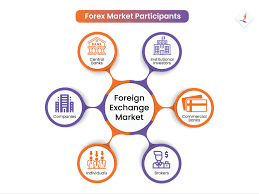
The Forex market includes diverse participants:
- Central banks
- Commercial banks
- Multinational corporations
- Hedge funds and institutions
- Retail traders
Each participant has different objectives, influencing price movements.
7. Currency Pairs and Quotation
Currencies are traded in pairs, such as:
- EUR/USD
- GBP/JPY
One currency is the base currency, and the other is the quote currency. Exchange rates reflect the value of one currency relative to another.
8. Speculation and Hedging
Forex serves two main purposes:
- Hedging: Reducing currency risk in international transactions
- Speculation: Profiting from price fluctuations
Speculation provides liquidity but also increases volatility.
9. Leverage and Margin
Forex trading often involves leverage, allowing traders to control large positions with smaller capital.
While leverage:
- Increases profit potential
- Amplifies losses
It requires disciplined risk management.
10. Volatility and Market Drivers
Currency prices are influenced by:
- Economic indicators
- Interest rates
- Inflation data
- Political events
- Central bank policies
These factors create constant price movement and opportunity.
11. Transparency and Pricing
Forex pricing is generally transparent but varies slightly across brokers due to:
- Liquidity providers
- Execution models
- Market conditions
Understanding how prices are formed helps traders avoid unnecessary costs.
12. Accessibility
The Forex market is highly accessible.
With:
- Internet access
- Trading platforms
- Small capital requirements
Retail traders can participate alongside major institutions.
13. Risks Inherent in Forex Trading
Despite its opportunities, Forex carries risks:
- Market risk
- Leverage risk
- Liquidity risk during extreme events
Risk management is an essential part of trading.
Conclusion
The nature of the foreign exchange market is defined by its global reach, decentralization, high liquidity, and continuous operation. These characteristics make Forex unique among financial markets and attractive to a wide range of participants.
However, opportunity comes with responsibility. Understanding how the Forex market functions is the foundation of successful trading and international financial decision-making.
Word Count:
316
Summary:
The Foreign Exchange Market is an over-the-counter (OTC) market, which means that there is no central exchange and clearing house where orders are matched. With different levels of access, currencies are traded in different market makers:
The Inter-bank Market – Large commercial banks trade with each other through the Electronic Brokerage System (EBS). Banks will make their quotes available in this market only to those banks with which they trade. This market is not direct…
Keywords:
forex, currency, trading, technical analysis
Article Body:
The Foreign Exchange Market is an over-the-counter (OTC) market, which means that there is no central exchange and clearing house where orders are matched. With different levels of access, currencies are traded in different market makers:
The Inter-bank Market – Large commercial banks trade with each other through the Electronic Brokerage System (EBS). Banks will make their quotes available in this market only to those banks with which they trade. This market is not directly accessible to retail traders.
The Online Market Maker – Retail traders can access the FX market through online market makers that trade primarily out of the US and the UK. These market makers typically have a relationship with several banks on EBS; the larger the trading volume of the market maker, the more relationships it likely has.
Market Hours
Forex is a market that trades actively as long as there are banks open in one of the major financial centers of the world. This is effectively from the beginning of Monday morning in Tokyo until the afternoon of Friday in New York. In terms of GMT, the trading week occurs from Sunday night until Friday night, or roughly 5 days, 24 hours per day.
Price Reporting Trading Volume
Unlike many other markets, there is no consolidated tape in Forex, and trading prices and volume are not reported. It is, indeed, possible for trades to occur simultaneously at different prices between different parties in the market. Good pricing through a market maker depends on that market maker being closely tied to the larger market. Pricing is usually relatively close between market makers, however, and the main difference between Forex and other markets is that there is no data on the volume that has been traded in any given time frame or at any given price. Open interest and even volume on currency futures can be used as a proxy, but they are by no means perfect.
Tinggalkan Balasan