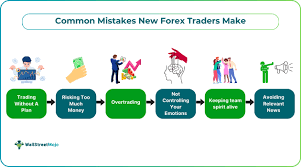
Every successful trader shares one thing in common: they were once beginners who made mistakes. Futures and Forex markets offer high liquidity, leverage, and opportunity—but they also punish inexperience quickly. Most new traders fail not because the markets are unfair, but because they repeat the same avoidable errors.
Understanding these mistakes early can save time, capital, and confidence.
1. Trading Without Understanding Risk
The most common and dangerous mistake is ignoring risk.
Beginners often:
- Focus on profit potential
- Ignore downside exposure
- Trade without stop losses
Professional traders think in terms of risk first, reward second.
2. Overleveraging the Account
Futures and Forex both offer leverage, which amplifies:
- Gains
- Losses
New traders frequently use excessive leverage because:
- Small price moves look harmless
- Margin requirements feel low
Overleveraging turns normal market fluctuations into account-ending events.
3. Trading Without a Clear Plan
Many beginners enter trades based on:
- Feelings
- Social media signals
- Random indicators
Without a written plan covering entry, exit, and risk, consistency is impossible.
4. Overtrading
More trades do not mean more profit.
Common causes:
- Fear of missing out (FOMO)
- Boredom
- Trying to recover losses
Overtrading increases transaction costs and emotional mistakes.
5. Ignoring Market Conditions
Markets change.
Beginners often:
- Use the same strategy in all conditions
- Trade during low liquidity
- Ignore volatility shifts
A strategy that works in trending markets may fail in ranging ones.
6. Moving Stop Losses Emotionally
A stop loss is a decision—not a suggestion.
Beginners often:
- Move stops to avoid losses
- Hope the market turns back
This turns controlled losses into uncontrolled ones.
7. Revenge Trading
After a loss, many traders:
- Immediately re-enter
- Increase position size
- Trade emotionally
Revenge trading is driven by ego, not logic—and it rarely ends well.
8. Unrealistic Expectations
Many beginners expect:
- Daily profits
- Quick financial freedom
- High win rates
Professional trading is about consistency, not excitement.
9. Ignoring Trading Psychology
Markets test:
- Patience
- Discipline
- Emotional control
Beginners underestimate the psychological side of trading and overestimate technical skills.
10. Not Keeping a Trading Journal
Without tracking:
- Mistakes repeat
- Strengths go unnoticed
- Progress is unclear
A trading journal is one of the fastest ways to improve performance.
11. Blindly Following Signals or Gurus
Relying on others:
- Prevents learning
- Creates dependency
- Transfers responsibility
Successful traders take ownership of their decisions.
12. Trading Too Big, Too Soon
Scaling up before consistency leads to:
- Emotional stress
- Poor decision-making
- Capital loss
Size should increase only after discipline is proven.
13. Underestimating Costs
Beginners often ignore:
- Spreads
- Commissions
- Slippage
These costs matter—especially for frequent traders.
14. Treating Trading Like Gambling
Without structure, trading becomes:
- Random
- Emotion-driven
- Unsustainable
Trading is a business, not entertainment.
15. Giving Up Too Soon—or Too Late
Some quit after minor setbacks.
Others refuse to stop despite repeated losses.
Both extremes prevent growth.
Conclusion
Most beginner mistakes in futures and Forex trading are not technical—they are behavioral. Knowledge alone is not enough. Discipline, patience, and risk management determine long-term success.
Mistakes are inevitable.
Repeating them is optional.
Learn early. Trade smart. Protect capital.
Word Count:
384
Summary:
There are many so called opportunities on the internet promising
vast riches for little work in the area of forex trading and futures
trading. Statistically 95% of beginning forex traders fail and quit.
In this article I hope to provide a little sane advice, to increase
this percentage for the good of all.
Keywords:
forex, futures, forex trading, futures trading
Article Body:
There are many so called opportunities on the internet promising vast riches for little work in the area of forex trading and futures trading. Statistically 95% of beginning forex traders fail and quit. In this article I hope to provide a little sane advice, to increase this percentage for the good of all.
If you are like me you were attracted to futures or forex trading because both financial arenas offer highly leveraged results, which means that your profit “potential” in the short term seems to be very high.
Human emotion such as hope and greed trigger at this stage as you see an opportunity to escape your daily grind, and get a better life for you and your family. There is nothing wrong with this, but it is at this point that I need to inject a dose of reality.
Remember – 95% of all beginning forex traders fail! I’m going to try your patience and repeat this.
95% of all beginning forex traders fail! This also applies to futures trading and just about any form of speculation.
The exact reason for this is that they have been sold an idea – a potential for profit and they just look at the goal. Now this is fine, but all goals to be achieved involve doing something.
There are no free lunches in this world.
This is the point that is not confronted. You absolutely MUST confront this point if you want to have any chance of success.
We have a couple of things working against us and it’s not just the skill of trading that needs to be developed.
- We are not used to getting something for nothing. Even if we win in trading we will believe that we just got free money and will unconsciously give it back.
- We do not have the experience, even though we may have the education.
Knowledge without experience is shaky!
Therefore, to counteract these negative factors, we must have at least 2 things in place.
- Trade a demo account for at least a few months until you can profit consistently from that.
- Discipline to follow a trading system
- A Money Management plan and policy.
Without taking at least these steps you are on very shaky ground and could be heading for the 95% class very fast.
I want you to be in the 5%

Tinggalkan Balasan